
Round Trip
by Emira Tufo
Montreal
Year after year, you live the last few weeks leading up to the annual pilgrimage to your hometown as if they were your last. The dread and the hunger kick in at twenty-one days before departure; once your remaining time falls short of a month, death feels very near. Three weeks, then, and weeks are such small units of time. Every day is Friday—no sooner has a week begun than you are already at its closure. Normally, every other week, you and Darling treat yourselves to Nacho Friday, but in the weeks leading up to your departure, you do Nacho Friday every Friday, and you allow Darling to grate in more cheese than you normally do when you are thinking of your arteries. Now, you are thinking of the pleasures you can still consume, even if you cannot take them to the grave. Thankfully, they are abundant and within easy reach. You catch the latest indie films showing at the local cinemas and order pastries at the coffee shop every single time. You finally go to the new ice cream parlor that specializes in matcha and eat two scoops instead of one. Suddenly, it doesn’t feel like too much: your stomach has more room. You rush to finish the novel you’ve been reading for a year because you can’t cross over to the other side without knowing how it ends. You watch the canna plant on the terrasse every morning, willing it to manifest its flowers before you depart. What you always think and fear is that your homebound flight will crash.
Sarajevo
The flight doesn’t crash, although you experience mortal fear at every bit of turbulence. You grab the person sitting next to you, realizing, with despair, that they, too, will be falling through the sky. There is nothing and no one to hold on to. You think it has come for you at last. You and your fate will bring down the entire aircraft and all your fellow passengers. You also tell yourself that this is absurd, that your fate cannot be so powerful as to overcome the other 400+ fates on board. But maybe that’s the thing: that you all share the same fate, which is why you’ve unknowingly come together on this flight.
You know you should feel more confident about your time on earth: thirty-one years ago, you survived your hometown at a time when others perished. You heard a clear sharp bullet whizz right by your left ear. You’d turned your head just a little at just the right time, and it missed you. You lived to know of its intentions. You didn’t think about it much then—or of the mortars that rained down on the buildings and sidewalks and crowds waiting for water and bread—unless you knew your mother and father were there waiting with their jerrycans. You, too, waited in those crowds nearly every day, but you weren’t afraid because you had bigger fish to fry. You watched the boy you had a crush on standing a few places ahead and worried about the state of your hair. You didn’t want him to turn around and see you looking like that. You wanted him to look when you were carefully coiffed, gelled-up, strolling in front of the basketball court. But he never took his eyes off the ball.
Gaza City
All you know is what you see and read in one of the national newspapers, and although some say that the words are too restrained and weak, they leave no doubt in your mind that this is hell of an entirely different order. Relative to this, your city’s killing was steady and slow. You wonder if, in your lifetime, only Rwanda may have been worse: up close, with machetes. You have a Tutsi friend who hid under the bed in a Hutu neighbor’s house when they came searching for his lot. By then, his lot was already dead. He alone remained, breathing quietly under the bed, listening to the comings and goings of their boots. You’ve only ever hidden in the basement of your building and the fallout shelter during intense bombings, and that’s the sort of thing one can hope to survive. And you did.
In the latest photographs of the unfolding tragedy, you see a long and miserable convoy passing by the sea: the destitute and dispossessed fleeing the rubble rising in the background, transporting their possessions in every which way: on their heads, in their hands, on their backs, and on top of their trucks and cars. The convoy is an endless dark smear stretching along the beach, punctured by the color of the travelling bedding, blankets, buckets and plastic bags. The article says that the convoy is heading south to save itself, but it also says that there is no safety, neither north or south nor east or west. The convoy carries its things as if it will need them, and you pray that it is so, but you’ve lost hope for an outcome in which any object will have any utility at all or any person left to serve. The convoy strikes you as a procession of phantoms, its fate already sealed.
Sarajevo
When you were living through the slow killing of your hometown, you listened to the news on a radio powered by a car battery hoping to hear that the American Sixth Fleet was coming to your rescue. You’d never even heard of the Sixth Fleet before, and then suddenly, it was on everyone’s lips. The Sixth Fleet had finally arrived in the Adriatic! Then, it hadn’t. And then again, maybe it had! Then, nothing. You looked to NATO, to the UN Security Council. Then, you put your hopes in the power of international public opinion. People demonstrated for Sarajevo. It boosted your morale for a while. Then, more shelling, more massacres. Then, Srebrenica.
Tel Aviv
You enlarge the photos with your thumb and index finger but can’t quite make out the faces in the convoy. You remember the faces of your own convoys from three-and-a-half decades ago, when old women in head scarves and teary-eyed children peered through the dirty windows of departing buses. They were photographs taken by foreign journalists mostly, and they are no longer allowed to bear witness.
You were once on a beach like the one that the convoy is now traversing, in Jaffa, visiting an Israeli boyfriend. He thought you two could build a life there, but you knew you couldn’t—not with your name and your history. You’d fled from war, for God’s sake, and this soil was bound to have many more. That was a long time ago. You lay in the sand under the sun, and two fighter jets flew overhead. It was some smaller war back then, and your lower back ached the entire time. It had seized up two days before your trip as if to prevent you from going, but you went despite the mounting political tension, and apart from that pain, had a wonderful time sampling restaurants and bars in Neve Tzedek and Florentin. You bought a mesh bracelet on Dizengoff Street that looked like a piece of medieval armor, and it is still your favorite piece. It always gets noticed and you always get asked. Now, you don’t say. After you left, your back pain disappeared.
Sarajevo
You made it out alive through a tunnel under the airplane runway. Now, three decades later, you return as both a tourist and a native. For over 30 years, you have been returning, and somehow, lately, with ever more fear. Why now, you wonder? Why would it fell you now when it didn’t fell you then? And why via plane crash? You could be struck by a Sarajevo tram or a drunk driver. Rubble could fall on your head. It could be anything. But anything is not what you fear. What you fear is the passage from your new life to the old one.
Today, as half tourist/half native, you buy a handcrafted bracelet in an artsy store, and while you are shopping, trying on necklaces and rings, you imagine the Gaza convoy moving by the sea, the sea wind blowing up sand, and the sun burning over skin and salty water. The convoy rattles and weeps. You zoom in on the convoy’s faces in your mind’s eye and they are demolished faces with blood shot eyes. You imagine there must be women in the convoy with babies in their bellies, women who dared to get pregnant at this doomed time. Women who eat dust and sand.
Gaza City
You look at photographs of tent cities the likes of which Vancouver, Victoria, Toronto and Montreal have never seen. A hungry, diseased favela of plastic, and still, on this wretchedness, the bombs rain down. You read about some teacher still holding class in one of the refugee camps. She says it’s important for the children who’ve been traumatized.
You were once a member of a group called Students Against Genocide: SAGE. You and the other SAGE members would lie on the ground in the main square of the university campus splattered with fake blood, holding up SOS signs. This was after the Rwandan genocide and during the Bosnian one. You thought that maybe it could be stopped if you clamored loud enough. Fellow students stepped around your fake-bloodied bodies or rode past you on their bikes. This went on for a few months, and then you gave up and delved into the novels of Milan Kundera: tales of personal drama under communism. Then, you moved further afield to Bruno Schulz and Isaac Bashevis Singer, to portrayals of African Americans in popular culture, to the new wave of Chinese cinema. Further and further you went. But every summer, you returned to your hometown.
Sarajevo
Wrist adorned with the new Sarajevo bracelet, fresh squeezed orange juice in hand, you click on the World section of your newspaper’s app. By “World,” you mean Gaza because this, as far as you’re concerned, is the state of the world. You cannot help but admire the discreet matte sheen of the bracelet’s brass and the thick silver ring that clasps its ends together like a handcuff.
Just the other night, you are sitting with a friend who pours out the shame he feels over his silence. You concur. You too have done little more than consume a sickening amount of news. We could click on the “Like” button, the friend says. And you could, but neither one of you wants to jeopardize your livelihood. He’s just been offered a job in academia. Like the character Marketa in Kundera’s The Joke, you have shit yourselves. Every now and then, your friend says, someone speaks up and gets maybe twenty likes on LinkedIn. Why should they continue to take such risks? It’s the prisoner’s dilemma, you suggest, and he says it isn’t because the prisoners already know what the other prisoners are going to do, which is nothing.
All the while, you munch on spicy Mexican pizza because it won’t help to starve yourselves in solidarity. And what would? Something more than the crumbs you’ve proffered by going to a protest, signing some petitions, and donating as much money as you do to the parrot shelter in Alberta. God help us, the friend says, because if there is one, which is a big if, then one day we will all be asked what we did when this was going down. You conclude you will both end up in hell.
Three decades ago, you looked to the world, and the world carried on like your crush on the basketball court: bouncing around, throwing casual hoops. The game is still on and you’re missing the mark.
Montreal
You have less than a week left in your hometown before you return to Montreal. The other direction always feels less fatal, although your origins could still ambush you from behind. In the days that remain, you will eat a lot more ćevapi and spinach pie. You will buy more stuff that will get noticed and you will say you got it in Sarajevo. Someone will inevitably ask: “Is it stable there now?” You are always surprised at the question because it’s been thirty years and tourism is booming. Visitors have been snatching up those handcuff bracelets as if they were being given out for free at the Montreal Jazz Festival.
Your flight back is surprisingly smooth except for a few slight drops at the very end, twenty minutes before landing. This is It, you think and grip the armrests with mortal fear. You’ve got the aisle seat and the three people sitting to your right are a family: they have no reason to include you in their end-of-life hand grabbing. But it turns out not to be It, and you are safely back in the land of the living.
The air is still warm like summer, but it feels like fall, which arrived while you were travelling. You find a handful of dead leaves in the basket of your bicycle. You unlock it and ride to the café where you order a drink and open the paper. You read in the World section that several western powers, including your own, have recognized the state of Palestine. Some hail and others protest this shift in foreign policy, but all you can think about is the rubble rising behind the convoy: a rubble that precludes future possibilities. And you know your rubble—you know the rubble of the Sarajevo City Hall in which Zubin Mehta conducted Mozart’s Requiem. You know the rubble of the Old Bridge in Mostar when it collapsed into the Neretva River after being struck by mortars more than fifty times. You know the rubble that once was your land: Yugoslavia. Something has risen from this rubble, yes, but it’s something permanently achy and sore, something like a phantom limb. But this rubble, you think, this rubble by the sea, is rubble of an entirely different kind: rubble from which nothing rises, neither bracelets nor savory pies. It’s rubble that will take a hundred years alone just to clear.
ABOUT THE CREATOR
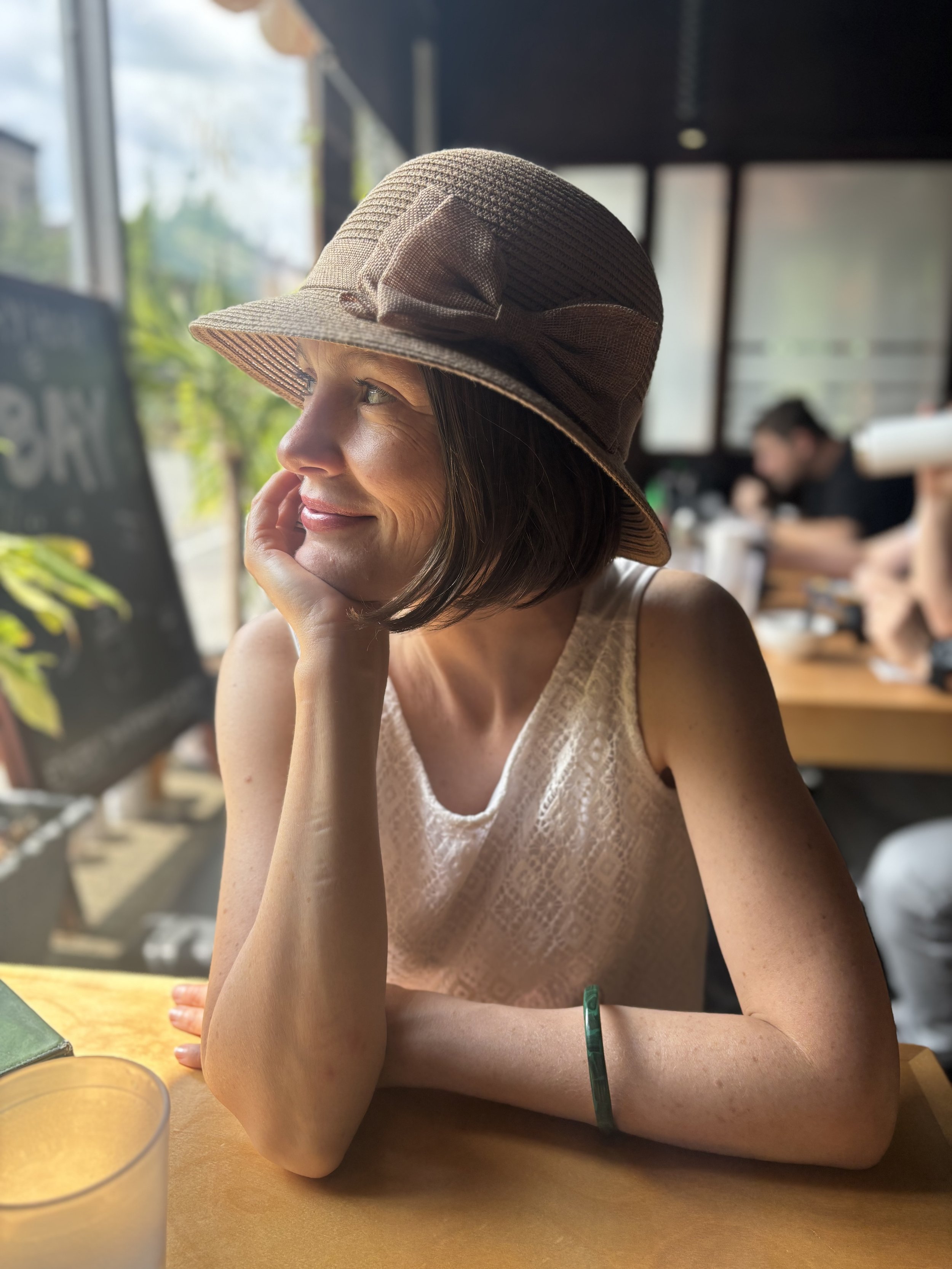
Emira Tufo is a Bosnian Canadian writer based in Montreal. Her work has appeared in various literary journals including The Iowa Review, The Fiddlehead, and The New Quarterly, as well as in The Globe and Mail, the Montreal Gazette, and the Ottawa Citizen. She is a former QWF/CBC writer-in-residence and a featured storyteller on the Confabulation and Volume Knob podcasts. She is currently working on a memoir about the siege of Sarajevo.
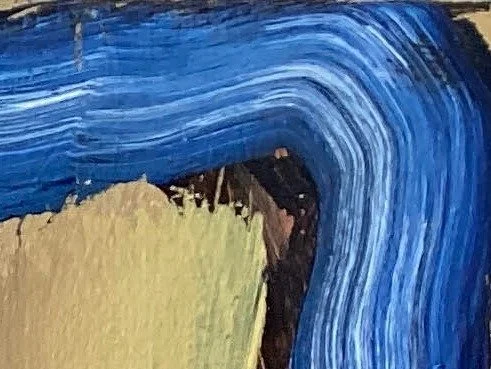
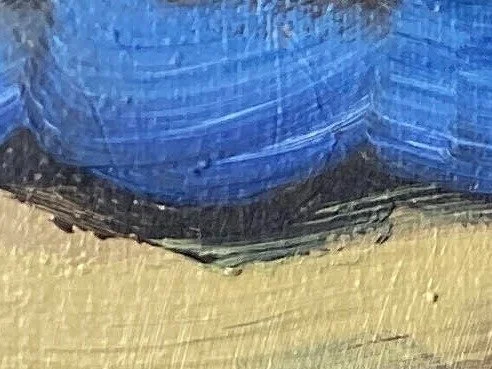
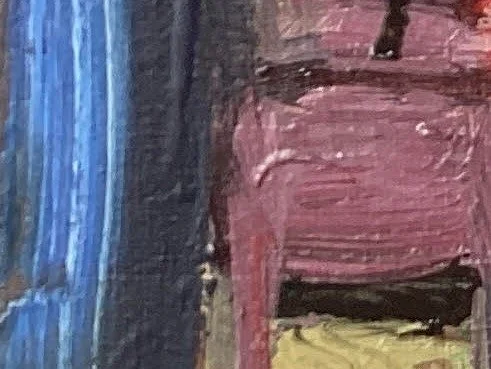
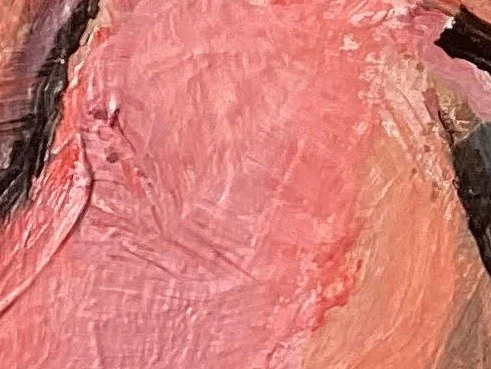
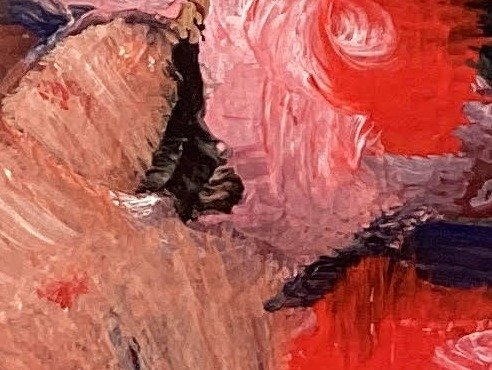
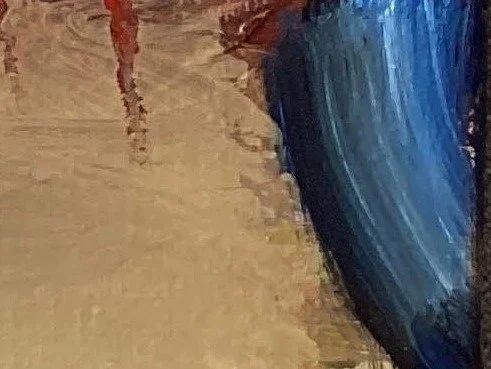
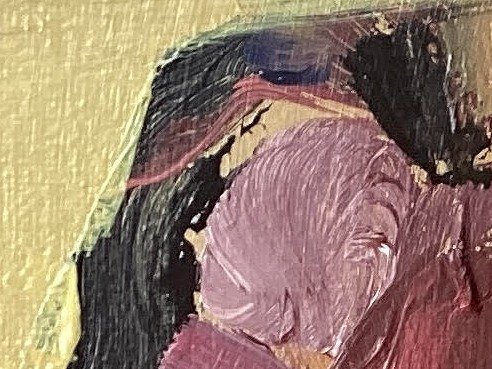
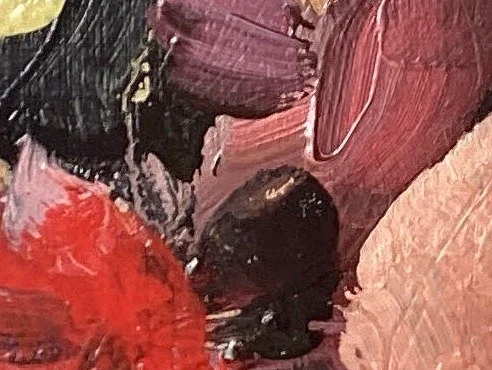
Cover art by Angie Quick
The oil painting “The actress (study)” is a work that explores the performance of sexuality. The painting borrows from imagery of the stage and asks the viewer what production are they witnessing.