In the Parentheses
by Elizabeth Jacyshyn-Owen
It begins, as such things often do, not with a declaration but with a sound file. A voice, timestamped, pressed like wildflowers into the coffin of an .m4a delivered at 3:12am local time, which is to say: inconvenient. Which is to say: intimate. Seventy-three seconds of vowel drift, of someone nearly remembering how to pronounce your name; still, it is enough to hold onto. A sort of placeholder for being perceived, as though you exist outside the screen, outside the hemispheric divide of GMT+1 and the glorious unknowns of +3.
This is where it starts: in delay. Delay becomes a scaffolding, a safehouse, because it’s easier to perform affection across a signal path, to revise and to reframe, to strip the sigh from the second line and replace it with a laugh. You write the part of yourself who is not tired, and you pace the kitchen not out of some poetic, tortured longing, but because the Wi-Fi is stronger near the sink.
In this version, you are not lonely. You are buffering. Which is to say: not quite. Which is to say: not you. And it’s easier—of course—to revise, to satisfy affection with a clean take. You find yourself grateful for the chance to edit the sneeze, to rerecord the joke that landed too sad, scripting spontaneity whilst roaming your hallway in boxers with holes and an old T-shirt that smells like bleach and almonds. And proximity might have corrupted it with errands and arguments and overlapping toothbrushes—but with a time zone’s worth of space, the thing is kept airless, embalmed: it never learns to breathe.
This is not sustainable, and yet it sustains. Limerence with no domestic infrastructure: no grocery lists, no birthdays that require planning. There are no wet towels to trip over, no hairbrushes to crowd the sink: only the pageantry of presence, the ritual greetings and the long-winded goodnights. You inhabit a relationship that could be described, charitably, as prepositional—between/around/near—but never with. You live together in the idea of each other, which is to say: you live nowhere at all, other than in an infinite airport terminal. And the problem, if you can call it that, is that you are never in the same room at the same time. The fantasy persists precisely because the body does not.
And it’s easy to be profound when you’re not expected to be present. You delete the part where you sounded too eager and your voice cracked like a teenager’s. I rerecord the part where I said I don’t know what I’m doing here and make it sound like a joke. I say I’d love to visit. You say you should. No one books a ticket: the verb is never conjugated. The verb rots on the vine.
I keep returning to the internal library card catalogue. The real kind, with brass handles that leave green fingerprints and wood varnish that smells of formaldehyde. No one uses them now, of course, not outside of set-dressed nostalgia: hotel lobbies with scent diffusers, Munich cafés with 7€ cortados (served in handmade ceramics by baristas who talk about Walter Benjamin like a roommate).
In my version, the drawers stick. Then yield. Each card: cream-turned-yellow, typeset in IBM Selectric, slightly damp. These are not reference cards. Not technically: they are closer to case studies or speculative memoirs—serifed, smelling faintly of toner and hand lotion (categorised not by Dewey, but by myth). And I read them the way one scans a menu when full. One they won’t order from, for fear of choosing wrong and being held to it.
There is the English teacher in Halifax, who wore linen year-round, quoted Auden to people who hadn’t asked. There are the three children in Vermont, with frozen peas in the sink and a calendar on the fridge marked with dental appointments. The dancer in Marseille, who smoked a pack a day on the beach, loved a sailor, drowned in sequins.
They go on like this. Hundreds. Thousands. They feel both familiar and completely inaccessible, each one a version refracted through glass. And no one prepares you for this: the vertigo not of scarcity, but of surplus. Not famine, but glut. And I read them as one reads gravestones in foreign countries. One is for the adjunct professor in Minneapolis, who taught Hegel at night and sold weed to undergraduates by day. The sous-chef in Palermo, who poisoned her own father (accidentally) and never cooked again. The milliner in Kyoto who only made hats for funerals and felt cloches shaped like question marks. Minnesota, widowed, second marriage, quiet contempt. French horn, English horn, Juilliard, migraines. Left accounting for mosaics, regrets it sometimes.
I take nothing. Except for one card I slip into my pocket—scandal, minor, Berlin, brief. It hisses. The other drawers mutter amongst themselves. One calls me sentimental. Another calls me a coward. And I sit on the floor, surrounded by a thousand Is, all written in third person, all narrated by a voice that sounds increasingly like my own.
The library has no exit. A fire door, probably, painted shut. I remember this too late. And I press my forehead to the brass pull. It’s warm. Someone else has tried this before.
This is not heartbreak. It is something smaller and stranger: more like a mutual haunting, both archivists of the present. And there are worse things than being unloved. One of them is being loved from 1,300 kilometres away with such clarity that your own reflection starts to feel pixelated, as if you only see the high-definition version. To be known in such granular, remote detail that you begin to forget your own depth of field. Your body pixelates under scrutiny. Your life, as lived, is the bootleg.
The subjunctive becomes the preferred address. You become a future conditional: a maybe. A probably not. Still, we build inside the parentheses—but then there is the body. And it returns sometimes, not in the flesh but in the ache. A specificity, somewhere between the ribcage and the inbox.
I send voice notes over coffee. You reply over tea. “You must be sleeping,” you say, and it feels intimate to know this. To be located not spatially, but temporally. To be imagined in the unconscious, because realness is not a function of coordinates: some of the most tactile memories are made of words, some of the most vivid touches have never happened.
We wonder what the other is doing: the sock adjusted, the habitual throat-clear. You understand that you will never know these things unless they are offered. You also understand they rarely are.
I begin my messages with breath. You smile before you speak. We know this about each other. And I watch the waveform of a voice as if it were weather, and you learn that communion can be observed in pixel (but only the version of you that fits in 128 kilobits per second). Not the one who wakes up anxious. Not the one who forgets to reply to their mother’s texts or who burns toast while writing sentences (like this one).
We both get very good at saying nothing. There are no declarations. That would ruin it. You speak instead in half-tones, in digressions. I listen to it twice. Then delete it. And you sit on a park bench and say things like this is enough (and mean it for about twenty minutes).
A cell divides and mutates. Falling asleep fully dressed, on top of the blanket (which inevitably leads to shivering). Sitting at the edge of the mattress rehearsing courage, willing yourself the strength to stand but instead hiding under the covers because your head hurts so bad and the light bothers you. Summoning whatever pitiful reservoir of courage you’ve got left just to drag yourself to the kitchen, mustering the guts to crawl (because it’s a crawl, not a walk).
You put your head on the table and call it plenty. And you’ve never been this tired. And when that doesn’t immediately alleviate your current bout of depersonalisation, you find yourself winding up so caffeinated your ears are ringing at harmonic frequencies known only to insects and certain breeds of dog.
The call came in at 6:41. I moved my tongue protectively over my teeth: a private, prehistoric gesture. You asked what I’d been up to. As if it were a neutral question: as if any version of nothing much could withstand scrutiny.
I’d already rehearsed the alibi twice: once aloud, once mentally (once again with the eggshell in my palm and no compost patch within reach). That’s not unusual. And I flexed the lie, tested its tensile strength. Too much: overcooked. Too little: spoilt. And I smiled (the way prisoners do in proof-of-life videos).
I said just – morning. I said making coffee. And the lie was so boring it sounded real. Outside, the garbage truck shuffled across the cobblestones, hydraulic sighs regular as breath. Inside, the other body moved. That was the part I never mentioned: the logistics of shame have a tendency to hover offstage.
And then I asked: Tell me—what are you looking at? What d’you see? Not what you felt: I don’t traffic in that currency. I asked what was in front of you, what the light hit. And you exhaled—a small sound, meant for yourself—and flipped onto your back (whether by accident or design: I could hear the bedsprings).
There it was. A prompt. An out. And you paused (I would remember that pause. I would assign it meaning; I would mine it for years). Because if you were telling a story, you weren’t interrogating mine. That was the exchange rate. And I pressed the phone harder to my ear.
You might have told me about the blackberries. The ones that bruised before you touched them, sun-warmed and performatively ripe, bleeding sugar. You might’ve said your hands were stained (you let them be stained). That the juice clung to your cuticles, that it reminded you of someone (not me). That you wouldn’t say their name because names are fixed things (and you hate fixed things). You might’ve talked lilies – tall and ghost-pale and spotted (how they leant toward the light). Your Babka’s net curtains. The bats in the rafters. The way they flitted in a long, dark ribbon across the grasslands, snaking past red-roofed farmhouses as you nursed your coffee, the first one of the morning, the way it tasted when the windows were still fogged.
Instead, you said zucchini. You said they didn’t grow right. How your Babka swore by eggshells and ancient superstition. How she muttered to the soil in a dialect you never quite understood. How it felt like a warning. Your voice went quieter there. You dropped out on the word beetroot.
This is how it happens: you offer an image (the smallest one you can find). A postage-stamp reflection. And you hold it up and let me project. And I—with my cathedral of projection—will take your fragments and make them narrative.
And later, I’ll write it down. Not exactly, but close enough. I’ll do the rest: fill in the margins, the closed captions. And I’ll call it memory—because it’s all a farce, really. And eventually, you’ll have to work with your propensity to defeatism, but for now, it’s enough to snatch up the fallen fruits, nails darkened with their ink. To drop, to split in half, exposed, watering your mouth. The earthy scent of the countryside, the breeze coaxing the first blossoms from their branches. That fat cat nestled on the bench next to you, folding your knees into your chest as you savour the sour tang of the berries. Their flesh, bursting against your palms, on your tongue, staring directly at the sun until your eyes bleed green spots that you can’t blink away. To offer your parents chay (bez moloka, of course). To endure, politely, the autopsy of an awkward adolescence, rolling your eyes at the parade of nostalgia. To push your father’s wheelchair through the groves in the late light, trousers tied in strange sailor’s knots above the absence of his legs. I didn’t ask. I assumed you’d explain it, eventually, if it served the story.
And somehow: this mattered. Not what you said—certainly not how you said it—but that you didn’t coat it in anything ornamental. That you offered something plain, almost accidental: something left out on the counter overnight and still edible in the morning. And later, I’d remember the pause before you answered. Longer than usual (like you were deciding whether or not I had earned it).
ABOUT THE CREATOR
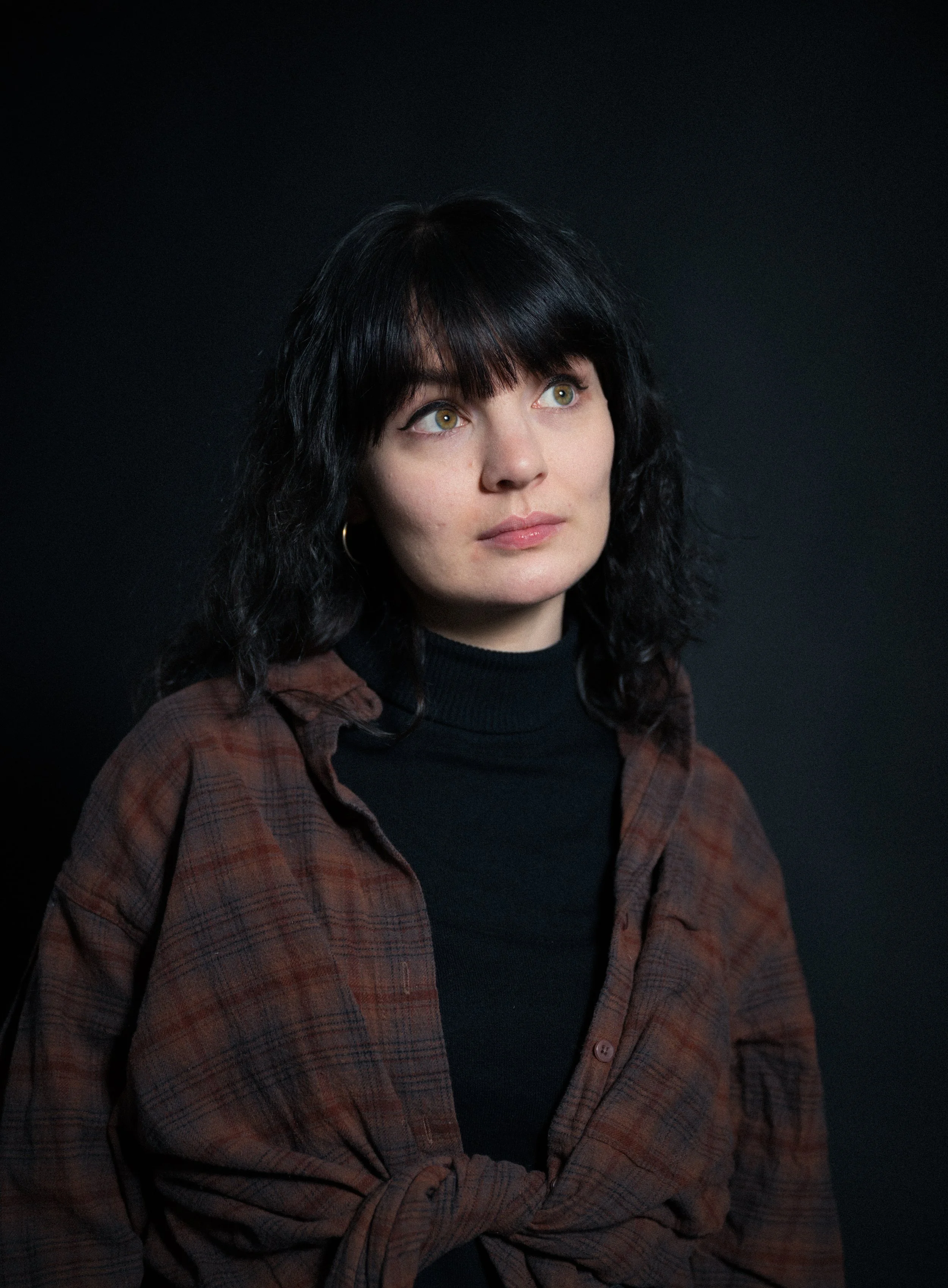
Elizabeth Jacyshyn-Owen is a writer, poet, and translator based in Leipzig. Her work has appeared in Dash Majesty, indieBerlin, MONTAG, NICHTS, Hidden Treasures, and Drunken Werewolf, among others. She is currently completing her debut novel, alongside a poetry collection and a series of literary essays that may or may not ruin a few dinner parties, and is a co-fellow for Anodyne Magazine’s 2026 Creator-in-Residence programme.
Instagram: @ejacyshynowen
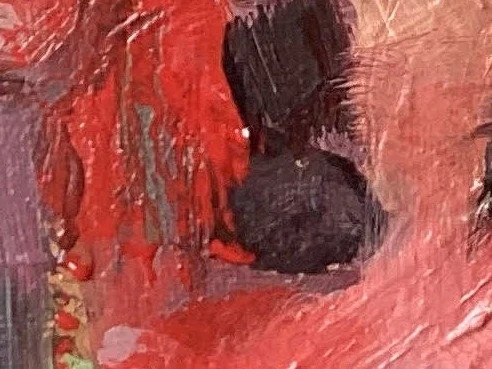
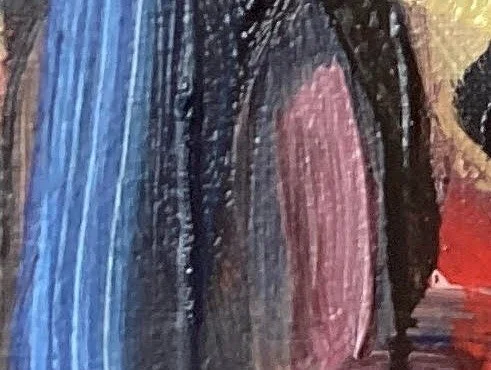
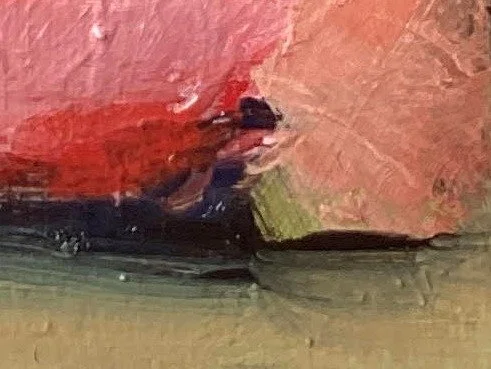
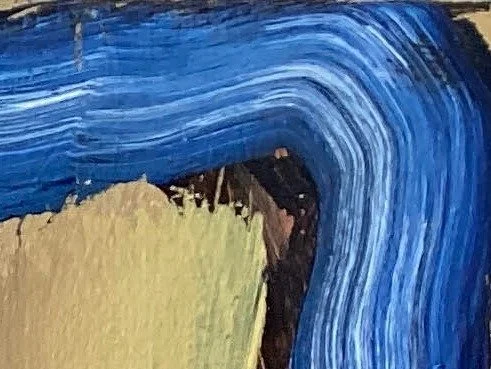
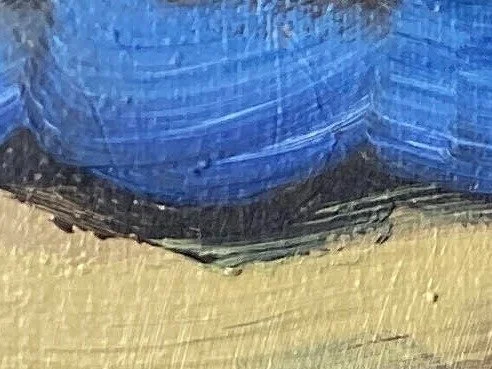
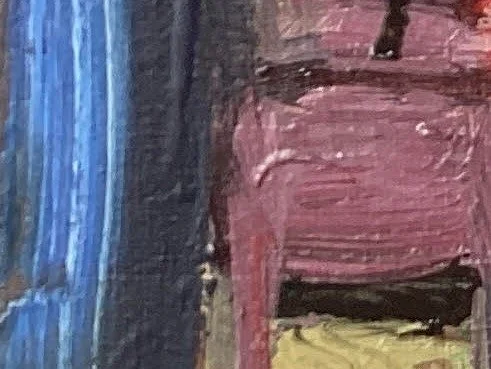
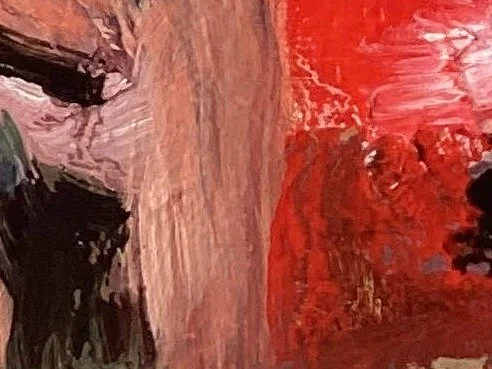
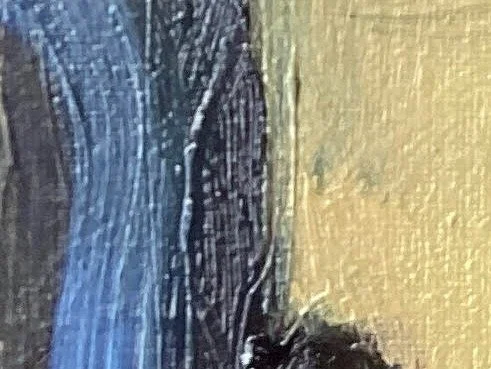
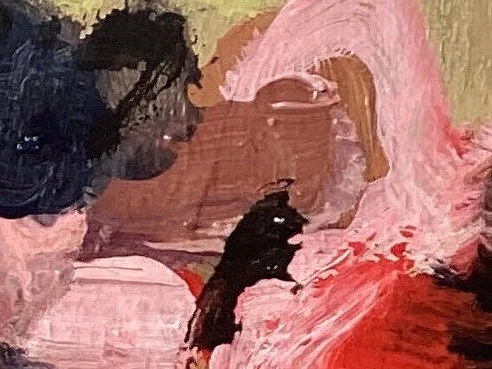
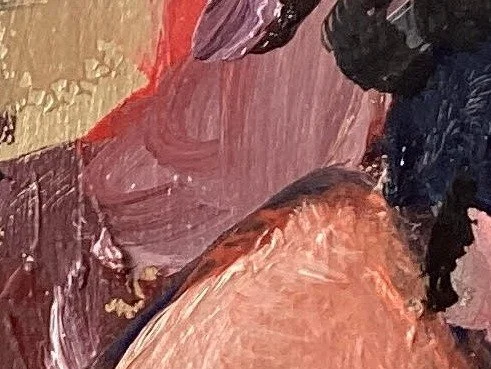
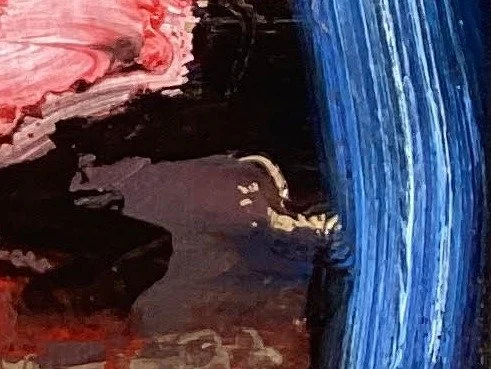
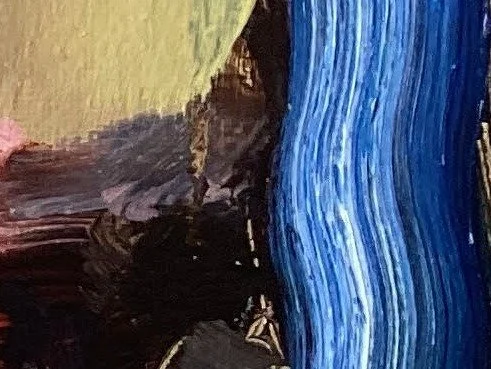
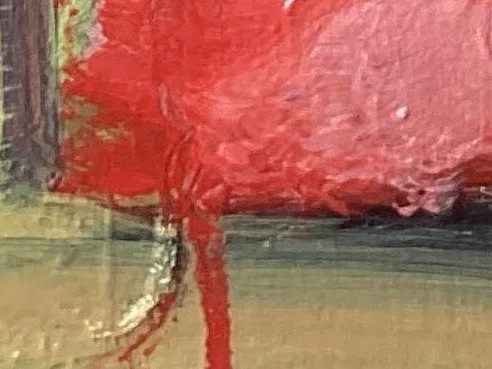
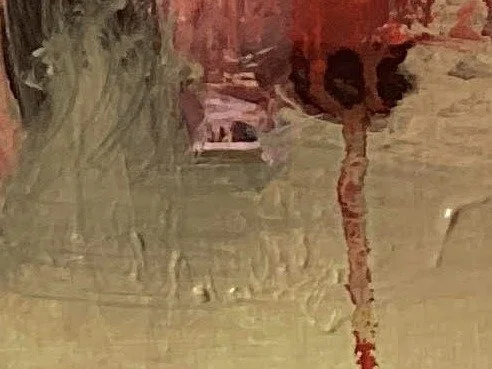
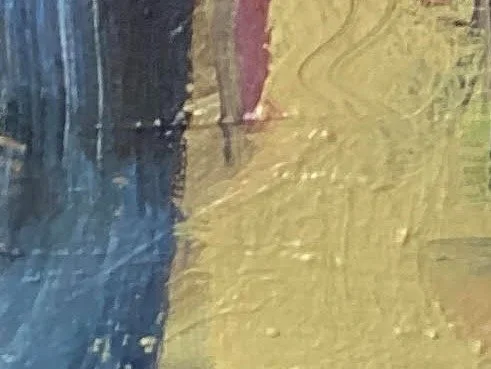
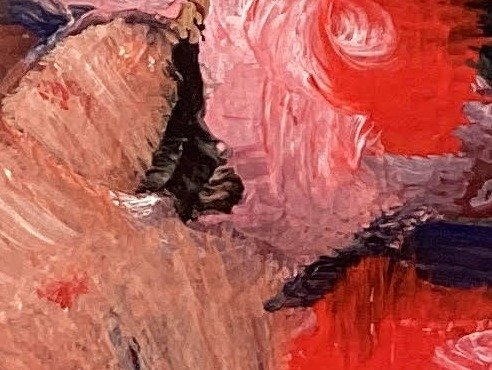
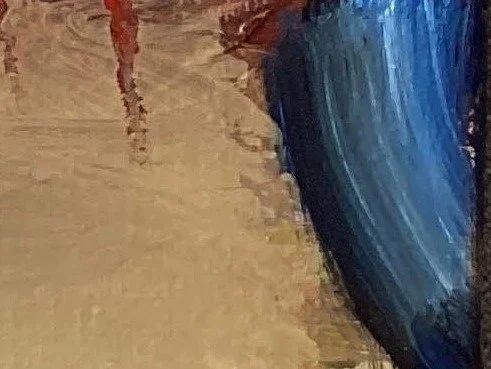
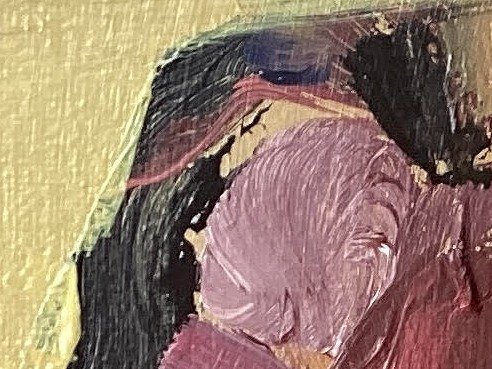
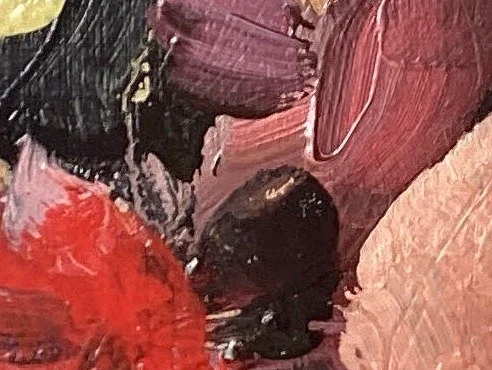
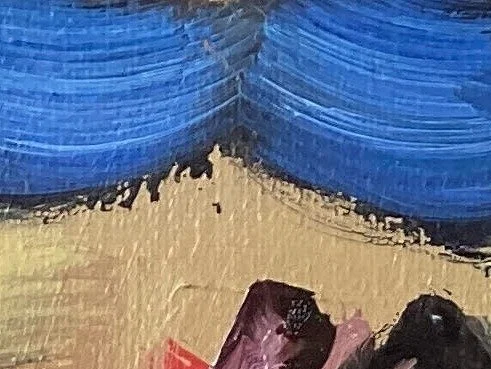
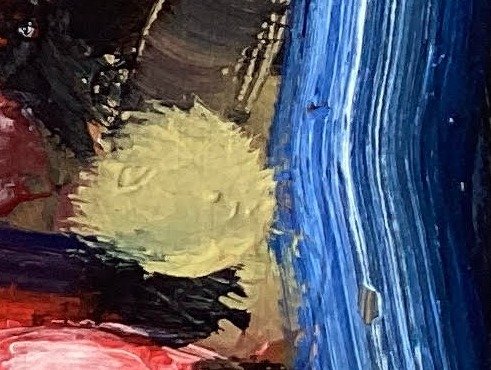
Cover art by Angie Quick
The oil painting “The actress (study)” is a work that explores the performance of sexuality. The painting borrows from imagery of the stage and asks the viewer what production are they witnessing.