
The Mountain
by Willy Blomme
The smoke is bad today. The fires are hundreds of kilometres away, in that space at the top of the map that was always a chore to colour in during elementary school, but they feel close. On the radio, I follow the evacuation orders for towns I have never heard of, but I know are somewhere vaguely up there – Lebel-sur-Quévillon, Val-Paradis, Oujé-Bougoumou. I wonder what these places look like. And what will be left of them.
The smoke is unsettling, but the worst part – more than the smell, more than the haze and more than the irritation at the back of my throat – is that I can’t see the mountain. I stand in the middle of Mont Royal – the street that shares its name with the mountain and with the city – and look towards where it should be, a wall shoring up the horizon. But the skyline is empty. If I make an effort, if I squint, I can just make out the ghostly grey outline of the mountain against the ash-orange sky. Present, but withdrawing from the toxic world.
I walk towards it.
I slip into the mountain’s forest by an entrance next to the cemetery. On another day, a stroll amongst the tombs and gravestones would have tempted me. A visit with bygone neighbours. But today, I’m not interested in human company, whatever its form. I am unnerved by the sky, by the smell, by the tickling in my eyes. I need a change of perspective. I head straight for the parting between the trees, hurrying to put some distance between me and the dog walker coming along the same path.
The mountain feels unfamiliar. The paths twist in unexpected directions. All of this green and heat feels strange. I know the mountain best in winter. I come here nearly every weekday evening from the first deep snowfall to the final decisive melt. It is all white then, broken up by dark trunks and rock.
A crisp February day. Warmer than last night. Cooler than last week. I hop on the bus where my street meets Mont Royal the street and hop off where Mont Royal the park begins. I wait until there is a pause in traffic, then, gripping my skis, dash across the four lanes of Chemin Côte-Sainte-Catherine. A footpath takes me up to the ski trail. It is steep and the snow is packed down and slippery from the feet that have gone before me. I have to use my poles to propel myself up. At the top, I stow my jacket in my backpack, clip into my skis, switch on my headlamp and push off. The first couple of strides are jerky as I test out the glide of the snow and the energy in my body. Then I settle into my rhythm.
When I take the second switchback on Chemin Olmstead, I ski by my first home in Montreal. It was a fifth-floor room in the brutalist university residence on the south-east part of the mountain. My window looked out onto the forest, so I spent my first year in the city watching the seasons paint the trees different colours. I became acquainted with the creatures that lived there – the squirrels, the woodpeckers, the sparrows. The squirrels I saw often, but the others were more timid. That is, until spring, when the ladybugs invaded, crawling all over my walls, my floor, my desk and my ceiling. Their incessant pitter patter becoming a tiny torture.
By the third switchback, where the ski trail begins to head more directly up towards the summit, the city’s hold loosens. The sirens and traffic drop away. A hush descends. This is where I settle into the mountain. Here, the snow and trees conspire to dampen the noise coming up from the streets. They create an oasis where sounds seldom heard down below take centre stage – wind rustling through branches, bird steps, the glide of skis, breath. During a snowfall, especially one that has just barely graduated from a rainfall, the sound of the snowflakes lands with mini muffled thuds on every surface. Calming, with an edge of menace. The trail here holds surprises. You need to watch out, no matter how often you come, for a different grip, for snow that packs on to the bottom of your skis, for a drift that you have to plow through.
Further along, where the trail shifts into a gentle curve, corkscrewing its way up to the top, the mountain’s forest comes into focus. The trees are thicker from here on up. They stand tall, with strong, solid trunks. Many reach their branches over the path, as if they are stretching to touch one another. But there is a gap. A patch of forest filled with dead trees. Long dead by the looks of it, their spidery black branches withered and brittle. I wonder if this is a natural cycle of death amidst life or something more sinister? A die-off due to our new insect invaders perhaps? This tract of decay must be the work of emerald ash borers. They have been in Montreal for fifteen years now – pushed up north by the warmer and warmer weather. Their larvae have munched through the trunks of thousands of trees, leaving only ghosts behind. They attacked isolated ash trees down in the city first, preferring to lay their eggs where the sun warms the exposed bark. Trees throughout the city had to be cut down, in an attempt to slow the spread. Trees like the majestic ash that once shaded my balcony.
I fish around in my pocket for a Kleenex – the indispensable accessory to any brisk ski – and pause to blow my nose in front of these dead trees. The ash borers came to the mountain anyway, despite the containment efforts. There is no treatment once the larvae have bored in, so I wonder if this patch of dead forest in front of me will spread? Or take over? What will be left of the forest then?
The trees provide a welcome shelter from the beating sun. Especially this summer, another record breaker. I am relieved that the mountain is providing me an escape from the heat bearing down on the city. I meander in the shade and the criss-crossing paths on the back side of the mountain, below the road that cleaves it in two. I pick my way along a trail that may or may not be open. There were no warning signs when I stepped onto it, so I should be fine. Still, I keep discovering that I have been walking on a closed trail once I come to the chain blocking it off where it meets a bigger one. The backwards letters on the sign hung in the middle sparking a little pang of guilt. I’m not worried about falling branches, the aftereffect of this spring’s flash ice storm. By now, those that were going to fall have already come down, but I do want to respect the work of the arborists. For the sake of the forest, but also, selfishly, in hopes that, if the experts are given the space to do their work, my favourite ski trails will be open again come the snow.
This spring’s ice storm was the worst in 25 years. Since the one that shut the city down for three weeks. I wasn’t living here then, but I watched the storm on the news, like everyone else. The images of collapsed Hydro towers and trees bowed over filled the tv screen and the pages of the newspaper. When I did move here, the sagging tree tops that littered the mountain still bore the mark of the ice’s weight. This time around, the ice storm’s damage was tempered by the rapid rise in temperature the following day. Once it hit double digits, the ice slid off the trees and power lines in a crashing crystal rainfall. Ominous and liberating all at once. Still, the power was out for four days and many hundreds of trees and thousands of branches were lost. Two months have passed since then, but up here on the mountain, the evidence of the storm is everywhere. One fallen tree lies across my path, tipped over and exposing its roots to chest height. I grab its smooth bark and slide under. I can see that a lot of clean-up has happened already. Branches and trunks have been chopped up and fresh mulch spread out on the forest floor. But there is so much more to do. Some of the damage is too subtle for my untrained eyes, but I know that it is there by the bright orange spray-painted lines ringing many trunks, condemning the trees – too structurally unsound to be allowed to stand in a park that receives more than five million visitors a year. I have passed a number already and worry about how many more dot the mountain. And how many will fall in the next ice storm. And the one after that? They are happening more often now.
Midway up the mountain, my blood pumping, this is where I stop to switch to lighter gloves. Here the trail evens out as I glide through the spectral patch of forest. The trees have been gnawed to a facsimile of themselves by the emerald ash borers. Ghostly branches still stretch towards the sky. It is unsettling, so I push on, using my agitation to drive me up the slope and away from the blight more quickly. Tonight the moon is full, or not far off, and the clouds are scarce. There is a soft glow on the mountain, as the moonlight bounces off the snow, mirroring the gleam from above. Some nights, the light turns the snow a muted violet. On others, like tonight, it shades the snow a soft amber. The trail up ahead of me is lit up so brightly that I keep checking over my shoulder for the faster skier with the bright headlamp coming up behind me, but they never come. Eventually I look up and realize that it isn’t another skier but the moon, glowing bright, illuminating the trail. I switch off my headlamp and let the natural light guide me.
Once I pass the lake, I know that a change is coming. For much of the trail up to the summit, the climb is gentle, hugging the forest on one side, and on the other, offering peeks at the buildings downtown through gaps in the leafless trees. But at the top, the terrain gets more difficult. Here, the parallel tracks of the ski trail dive directly into the forest, revelling in steep climbs, sharp turns, and devilish descents. My chin still tingles where it lost its skin several years back on a slope that had iced over. But there is a reward for the hard work of navigating these trails. The mountain is more intimate here. A busy world reveals itself: Owls, bats, even foxes. I have never encountered one, but I hope to one day – from a safe distance.
My ritual on my evening skis is to pause for some water and chocolate under the illuminated cross at the top of the mountain. I could see it from my second home in the city – an apartment that I shared with three other university students. We lived a half hour walk from the mountain, fully ensconced in the city, but from my window, my gaze was drawn to the cross. Lying in bed at night, its light settled over me. A gentle illumination. But here, underneath the city’s iconic landmark, there is nothing gentle. It feels like a bunker. The massive concrete arches are topped by a maze of criss-crossing steel beams. The romance of the cross’ glow is undone by this coarse material. Still, it is a good spot to rest and look out over the lights that stretch down to the river. Just not for too long. Before my extremities have time to chill, I am off again, sticking carefully to the curving trail, staying on the safe side of the edge marked off by boulders that hint at the drop just beyond.
My path takes me to the edge of the road, but I turn back. I don’t want to wait for a break in traffic to dart across. That side of the road is all cemetery anyway.
Here, on the far side of the mountain, the side I never explore in winter, there are more barriers. Not just the closed walking trails, but fences. Lots of fences. The park staff are closing off rogue trails. Trails that emerge from visitors’ feet treading on plants. The short cuts that separate plants from their brethren, making it harder for them to flourish. We aren’t very good at sharing the mountain, evidently. Metal fences topped with yellow plastic flags offer me a choice of three different approved routes, like a garden maze that tentacles all over the slope. I stick to the prescribed path straight ahead of me, but there are so many others who don’t. They push over and through the fences, defiantly stamping their imprint here – their litter, their cigarette butts, even their graffiti. Up ahead of me is a rock tagged in red and over there a tree in blue. I scowl and continue on my way.
I wonder if the man who attacked me came this way? Along one of these rogue paths? I thought it was a mistake at first. A skier off-balance and falling into me. It took me a few seconds to register through two layers of thermal clothing the fingers squeezing, groping. I’ve always thought I was a flight over fight person, but my skis were pointing uphill. I couldn’t move faster than him in that direction. And I was angry. This was my mountain. My solace. I whipped around and brandished the sharp tip of my pole – suddenly a pseudo-weapon. He froze. A Michelin Man of indecision. Then he took a step back, slipped off the edge of the trail and fell on his ass. Cartoon legs flailing, he picked himself up then scurried down the staircase behind him back into the city. There was no trace of him a few seconds later when a group of skiers coming down the mountain glided by. But my anger remained. And something sinister sunk into the snow.
A little beyond one of the trees bent over by the ice storm, I see a flash of yellow – five delicate flowers, discreet, but standing out against a sea of green. Then I notice a pink flower a little further down. And further again, a patch of white baby’s breath next to the trail. I am surprised to see them. I think of the mountain as covered in trees alone. That’s what I see in the winter and on the horizon rising up beyond my neighbourhood. I forget about the plants down here at ankle level. The ones making a private life for themselves.
I have followed the flowers too far and now I don’t know which path leads where. I am lost. I have a brief moment of panic, but I refuse to get worried. I am in the middle of the city after all. Hardly far from help if I need it. But in the back of my mind I hold the memory of the doctor who slipped off the trail next to a cliff on a late-night walk with his fiancée. A freak accident. He was a friend’s former lover. I never met him, but he loomed large in my early years in this place. An enigmatic figure in her stories, lending the city a sense of mystery and adventure. I decide to stick to the path I am on. Dusk is settling in. I am starting to feel a bit anxious, and then silly for feeling anxious only eight kilometres from home. Or is it nine? Just keep going, I tell myself. Something recognizable will emerge eventually.
It does, but it is not what I expect. Drum beats. At first an unclear rumble, then a pattern. The rhythm that comes to the base of the mountain every Sunday. The Tam Tams that have been gathering there for decades for as long as the weather is warm enough. I spent many a Sunday there myself in my first years in the city. Not drumming, but soaking in the beat and the life that collected around it. Sitting on the grass with my new friends. Now I follow the sound, my anxiety melting away as the drum beat gets louder. As I emerge from the forest, the city rushes up to meet me. The traffic careens by, a crowd cheers over at a nearby soccer field, and the street lights shine bright red and green.
Heading back to my apartment, I walk along Mont Royal, the street. It is car-free for the summer, so I walk straight down the middle, following the route that the bus takes me along in the winter. The smoke from the fires has cleared somewhat by now and in the distance I can see the angled spire of the Olympic Stadium rising above the yellow line in the centre of the road. With the cars and the smoke both gone, there is an ease to being outside. Some people laugh on patios that spill into the street. Others lounge on whimsical wooden furniture. But most of us stroll, unhurried and unworried.
Up ahead of me, at the corner where I will turn north, I see the vegetable gardens. Les jardins nourriciers. They are a new addition to the summertime transformation of Mont Royal the street. An earnest experiment amidst the cultivated carefree spaces. Alongside the beds of plants and the picnic tables are handprinted signs announcing workshops on urban agriculture. I wonder if these are meant to prepare us for the world to come or if they are just an attempt to claim some element of life back from the concrete and the tar?
The road flattens out as I approach the gardens. I have walked along this street for years, the mountain at my back and my chores out in front of me. It is the spine of my life in this city. But it feels different today. For the first time I feel the slope, the mountain’s slope, here, under the asphalt, supporting me. Carrying me home.
about the creator
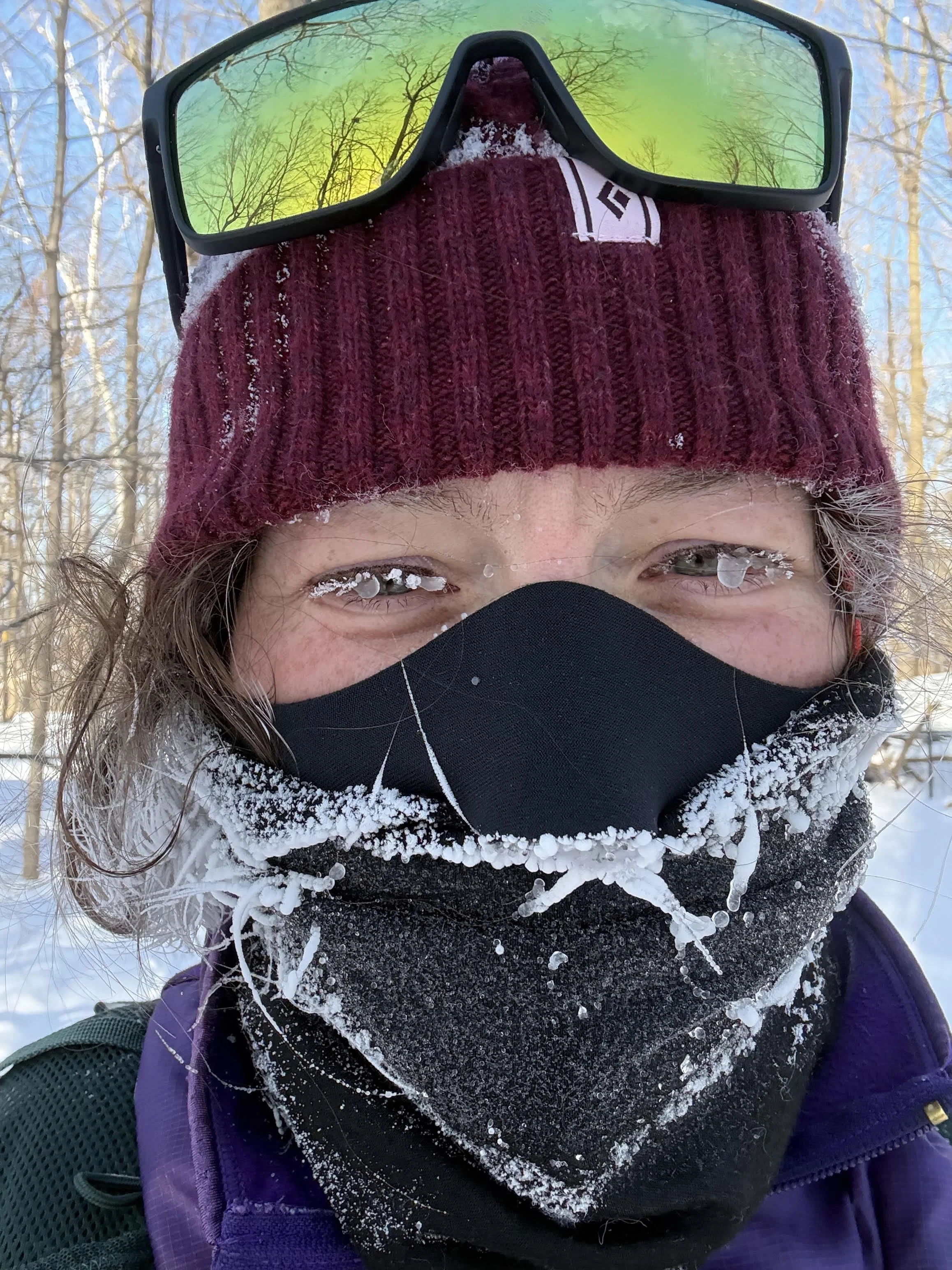
Willy Blomme has published fiction and nonfiction in Prairie Fire, Perspectives Journal, Ricochet, Theory & Event and The Contemporary Condition. Her short story “The Museum of Winter,” won silver for fiction at the 2023 Canadian National Magazine Awards. She lives and works in Montréal. Come the first snowfall, she is most likely to be found out on a cross-country ski trail.
Instagram: @willyblomme
Photography by Maggie McPhee
Traveling to Barbados with my family for Christmas. A set of three diptychs. A string of Christmas lights. A rope that I pull at. I want to get there but I never can.